

A DHS officer in Portland, Oregon
In early 2026, we at the Impact Fund watched in horror as federal immigration enforcement efforts came to a dramatic and violent head in Minneapolis. As a funder of public interest impact litigation, we knew it was time to act. We launched the Immigration Rapid Response Fund to support lawsuits seeking to hold immigration enforcement agencies accountable for unlawful and unconstitutional acts.
Since the start of 2026, we’ve provided $191,500 for impact cases brought by immigrant communities. In doing so, we reflected on the root causes of the crisis, as well as the deeply impactful work being done by legal advocates across the country. We asked our Summer Grants Intern Simone Faulkner to share these learnings in this blog series.

Simone Faulkner, Impact Fund 2026 Grants Intern
On his first day in office in January 2025, President Donald Trump issued an executive order declaring a national emergency at the U.S. southern border, where he immediately deployed 1,500 active-duty troops. Six months later, the One Big Beautiful Bill was passed, allocating $175 billion for border and interior management over four years—an amount larger than the entire annual military budget of most nations. Over the nearly two years following Trump’s inauguration, the number of active-duty troops at the border has grown to 10,000, the number of Immigration and Customs Enforcement (ICE) agents more than doubled, 675,000 people have been deported, and four innocent people were publicly killed by federal officers—Alex Pretti, Renee Good, Lorenzo Salgado Araujo, and Joan Sebastian Duran Guerrero—all under the premise of keeping the public safe.
This unprecedented immigration crackdown has resulted in a system of unjust arrests, brutal force, constitutional loopholes, prolonged imprisonment, and perverse enrichment. These abuses are not coincidental; they are part of a strategic effort to exploit and erase immigrant communities.
This three-part series will track the coordinated scheme of unchecked power that has created the current detention-industrial complex. Each part of this series will share how public interest legal nonprofits are responding, highlight the cases the Impact Fund has funded, and offer opportunities for community involvement and resistance as we look for a way forward.
The abuse of immigrants doesn’t stop after the arrest has taken place. This second post in the series will examine how the Trump administration and DHS have created a system of indefinite detention for immigrants and others entangled in the U.S. immigration system. By exploiting a constitutional loophole, the administration has undermined the civil and due process rights of immigrants.
For more information on issues involved with immigration-related arrests, such as dehumanizing quotas, targeted ICE recruitment, and violent tactics, see the first blog post in the series.
Constitutional Loophole
In July 2025, DHS reinterpreted a 1996 immigration law (8 U.S.C. § 1225) to reclassify long-term undocumented and paroled immigrants as “arriving aliens.” Immigrants who had lived in the U.S. for years, raised families, held jobs, and built communities were suddenly classified as “arriving aliens.” This was a strategic decision by DHS, as arriving aliens have no right to a bond hearing before an immigration judge. In September 2025, the Board of Immigration Appeals made this interpretation of the law binding nationwide.
Bond hearings allow individuals to explain their unique circumstances to an immigration judge and potentially secure a lawful path forward. Without this right, long-term residents can be forced directly into detention without ever appearing before a judge.
Weaponized Facility Transfers
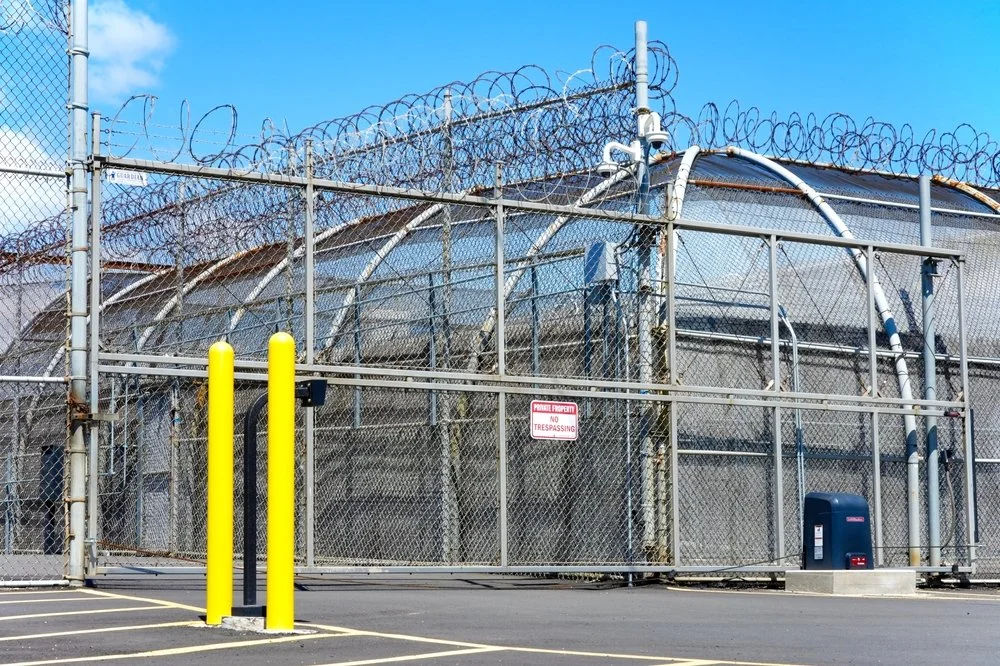
Delaney Hall, a DHS detention facility near Newark Airport
Once detained, ICE has rapidly transferred individuals from state to state and facility to facility, rendering detained people nearly impossible to locate. In some cases, they appear to have vanished into oblivion.
Badar Khan Suri was a Georgetown University fellow studying in the U.S. on a student visa when he was arrested by federal officers outside his home in Arlington, Virginia, in March 2025. CNN reported that Khan Suri was first handcuffed and taken to the ICE field office in Chantilly, Virginia, for fingerprinting, collection of DNA samples, and paperwork. In the middle of the night, he was moved to a detention center in Farmville, Virginia, then later to an ICE office in Richmond, Virginia. Next, he was taken to an airport in shackles and flown to a detention facility in Alexandria, Louisiana.
There, three days after his arrest, Khan Suri was told he would be flown to New York the next day but was instead driven to the Prairieland Detention Center in Alvarado, Texas. At Prairieland, Khan Suri slept on a thin plastic mattress, was given dirty, used underclothes to wear, and was refused religious accommodation. In total, Khan Suri was taken to 5 different locations and transferred 1,300 miles away from home. All the while, two Virginia detention facilities near his home were operating under capacity.
In the first seven months of 2025, almost 77% of detained immigrants were transferred between facilities at least once. ICE’s detainee locator website does not always reflect real-time locations, and the whirlwind transfers can leave people unreachable for days.
This tactic leaves detainees’ families in the dark. It also hurts lawyers’ ability to locate or communicate with their clients, making it difficult and sometimes impossible to challenge their detention.
Subverting Civil Rights
The primary legal tool to challenge unjust detention is a habeas corpus petition. This type of legal request originated under the Magna Carta in England more than 800 years ago to prevent the king from disappearing prisoners without just cause or due process. Now, habeas corpus is considered a civil right in the U.S., allowing individuals who have been detained by the government to challenge the legitimacy of their detention in court and petition for release. A habeas corpus petition requires that a detainee be physically present before a judge, so that the judge can then evaluate the legality of their confinement. This civil right applies to both U.S. citizens and non-citizens alike.
Critically, habeas corpus petitions must be filed in the district where the individual is detained. If a person is transferred to several different detention centers in a short time, it is very difficult for their lawyer to file the habeas petition. The circuitous process of rapid transfers establishes a cycle that prevents lawyers from effectively advocating for their clients’ release.
Only Congress has the authority to suspend habeas corpus, and only “when in Cases of Rebellion or Invasion the public Safety may require it.” Without the power to suspend habeas corpus, DHS and ICE are exploiting the “arriving alien” classification loophole and using rapid transfers to circumvent detainees’ constitutional protections and keep more people in detention.
Detention Alley
Fourteen of the twenty largest detention facilities are located across Texas, Louisiana, and Mississippi—disturbingly nicknamed “Detention Alley.” These three states are covered by the U.S. Court of Appeals for the Fifth Circuit, an appeals court that historically has been more likely to rule in favor of the administration. In the first year of Trump’s second term, almost three-quarters of people deported by ICE were last transferred to a state in the Fifth Circuit.
This is not a coincidence. The location where ICE detains someone determines where their habeas petition must be filed—and therefore which court will hear their petition. In a report by The Marshall Project, Dan Gividen, a Texas-based immigration lawyer and former Deputy Chief Counsel for ICE, acknowledged the purposeful transfer of detainees to facilities covered by the Fifth Circuit: “It’s in no way surprising that ICE in many ways gets to forum-shop, gets to choose the judge, [and so] is sending people to this circuit.”
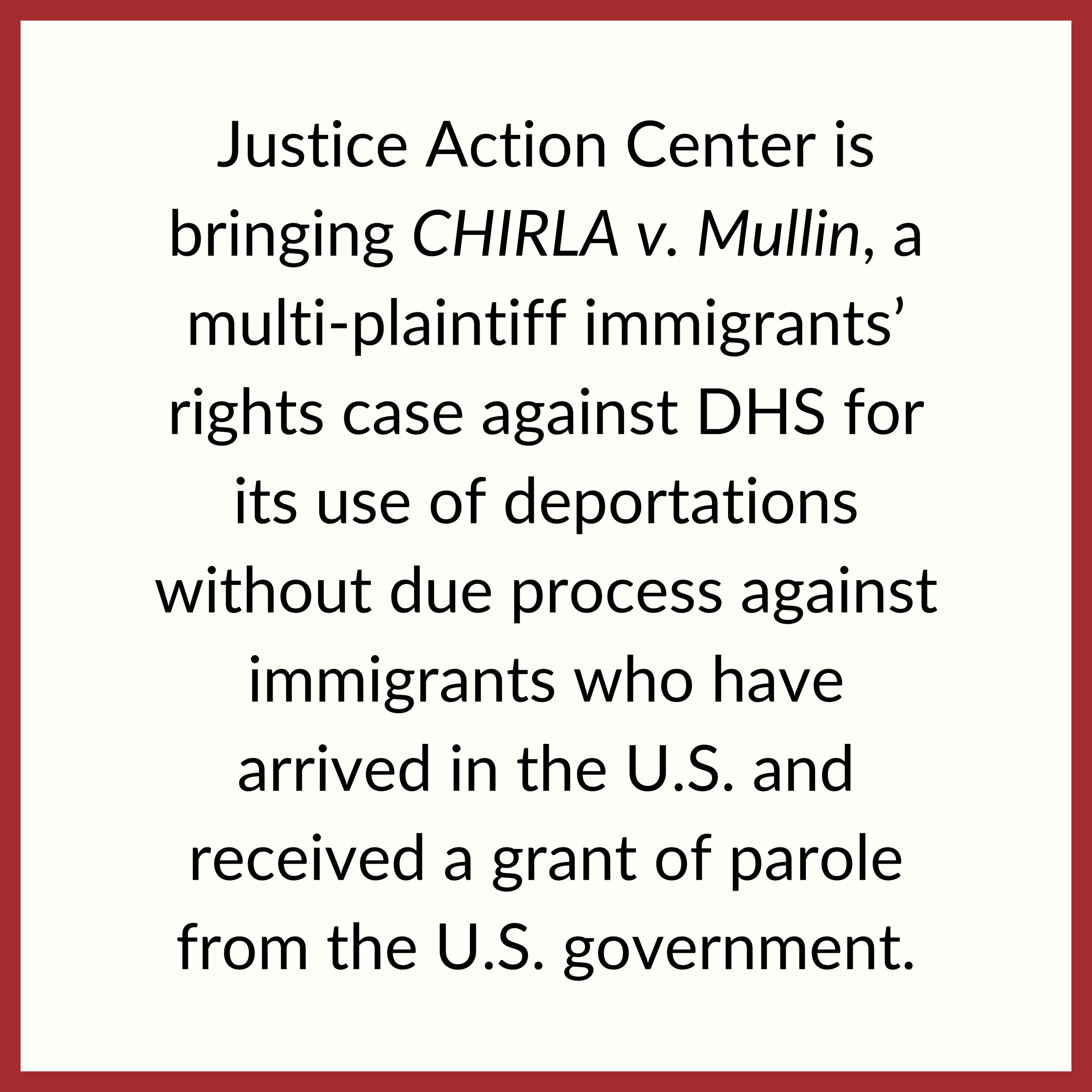
Impact Fund provided a grant of $10,000 to support this case.
The Problem Is Systemic
The reclassification of immigration status and use of rapid transfers are administrative strategies in a larger plan to undermine immigrants’ civil rights. By eliminating the right to bond hearings and blocking habeas corpus petitions, DHS and ICE have been able to establish a system of prolonged detention and unlawful deportations.
The right to due process is fundamental to the rule of law. In a dictatorship, autocratic leaders can remove their opponents without consequence. In a democracy, due process mechanisms create necessary accountability and transparency. DHS’s strategic circumvention of immigrants’ civil and constitutional rights pushes the dial of our democracy closer to authoritarianism.
Legal loopholes and wild goose chases, as harmful as they are, are not the whole story. What happens next is easier to ignore and harder to trace. The detention-industrial complex is a sinister, deep-rooted system that allows a few to profit off the suffering of many. Read more in the third post in the series.
How to Help
Donate to bail funds to help immigrants get out of detention.
Volunteer for detention hotlines.
Help immigrants transition back into their communities after their release.
Provide essentials, interpretation services, transportation, and accompaniment to important appointments.
Urge your Members of Congress to block ICE detention expansion.
Check out the Detention Watch and National Immigration Project Toolkit From Raids to Deportation, which explains how to navigate the detention process, how to contact a person in detention, and how to find a lawyer.
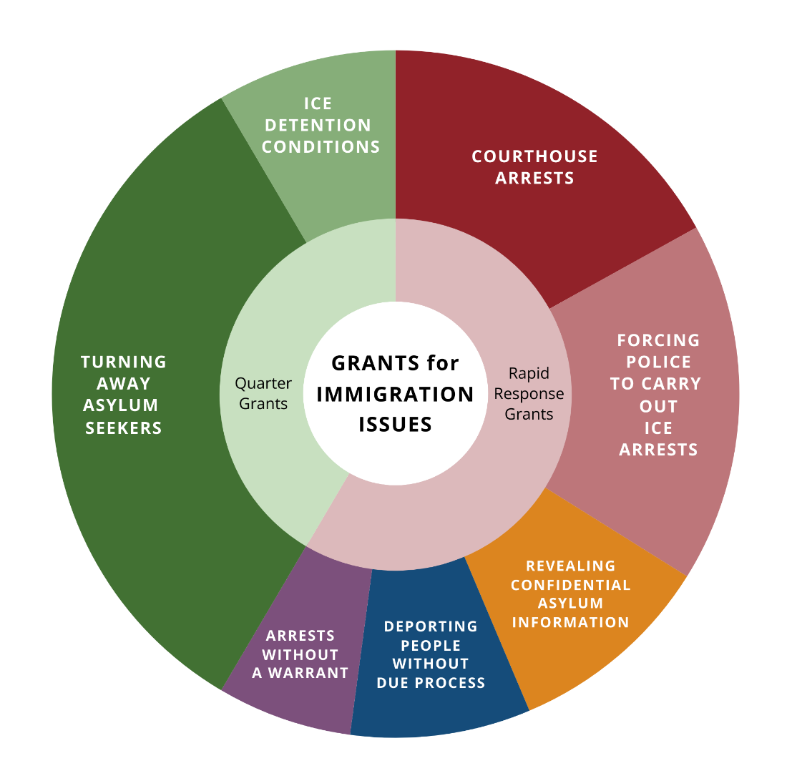
Immigration Cases We’ve Funded in 2026:
Production Credits
Author: Simone Faulkner
Researchers: Simone Faulkner, Joshua Kay, Megan Flynn, Amy Daniewicz
Editors: Lindsay Nako, Lucy Barton, Amy Daniewicz
Web Producer: John Henry Frankel
Web Editors: Teddy Basham-Witherington, Lindsay Nako