

A DHS officer at a protest of an ICE facility in Broadview, Illinois.
In early 2026, we at the Impact Fund watched in horror as federal immigration enforcement efforts came to a dramatic and violent head in Minneapolis. As a funder of public interest impact litigation, we knew it was time to act. We launched the Immigration Rapid Response Fund to support lawsuits seeking to hold immigration enforcement agencies accountable for unlawful and unconstitutional acts.
Since the start of 2026, we’ve provided $191,500 for impact cases brought by immigrant communities. In doing so, we reflected on the root causes of the crisis, as well as the deeply impactful work being done by legal advocates across the country. We asked our Summer Grants Intern Simone Faulkner to share these learnings in this blog series.

Simone Faulkner, Impact Fund 2026 Grants Intern
On his first day in office in January 2025, President Donald Trump issued an executive order declaring a national emergency at the U.S. southern border, where he immediately deployed 1,500 active-duty troops. Six months later, the One Big Beautiful Bill was passed, allocating $175 billion for border and interior management over four years—an amount larger than the entire annual military budget of most nations. Over the nearly two years following Trump’s inauguration, the number of active-duty troops at the border has grown to 10,000, the number of Immigration and Customs Enforcement (ICE) agents more than doubled, 675,000 people have been deported, and four innocent people were publicly killed by federal officers—Alex Pretti, Renee Good, Lorenzo Salgado Araujo, and Joan Sebastian Duran Guerrero—all under the premise of keeping the public safe.
This unprecedented immigration crackdown has resulted in a system of unjust arrests, brutal force, constitutional loopholes, prolonged imprisonment, and perverse enrichment. These abuses are not coincidental; they are part of a strategic effort to exploit and erase immigrant communities.
This three-part series will track the coordinated scheme of unchecked power that has created the current detention-industrial complex. Each part of this series will share how public interest legal nonprofits are responding, highlight the cases the Impact Fund has funded, and offer opportunities for community involvement and resistance as we look for a way forward.
Illogical & Inhumane Quotas
In May 2025, just months after the presidential inauguration, administration leaders set new immigration-related arrest goals that would triple the arrest figures from earlier in 2025. These new quotas demanded that federal agents arrest 3,000 people per day, totaling more than one million per year. The pressure to meet this extraordinarily high quota has driven ICE to adopt drastic and untested new tactics in recruitment, interagency partnerships, and arrest methods. A year and a half later, this system of quotas remains in place and has had tragic effects in immigrant communities.
The Last Place You Want White Supremacists
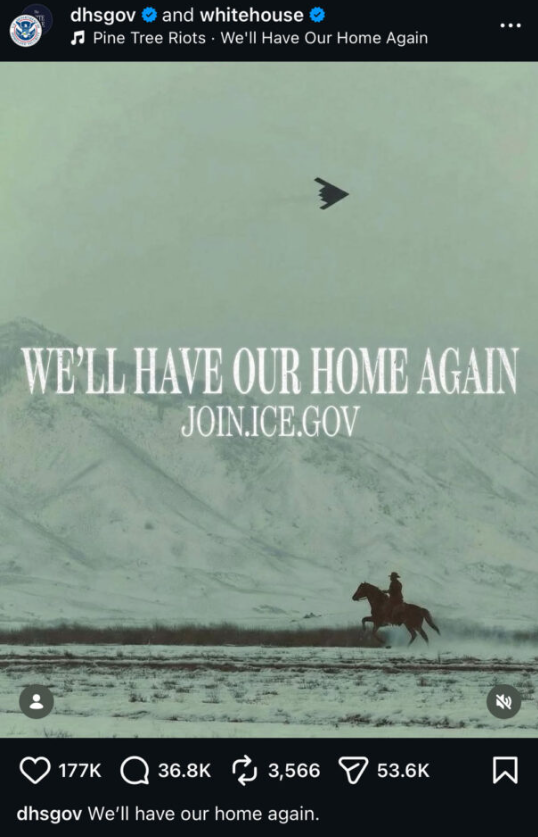
The Department of Homeland Security (DHS), the parent agency to ICE, frames the mass deportation agenda as a “mission to defend the homeland,” purporting to expel millions of criminals, calling them “the worst of the worst.” Yet its accompanying recruitment campaign has used tactics that speak directly to those in white supremacist circles. For example, multiple social media accounts operated by DHS shared a post encouraging people to apply to ICE with the caption, “We’ll have our home again,” accompanied by a song attributed to a white nationalist group.
Many objected to this recruitment strategy, concerned that agents would be motivated by racial bias and less likely to follow laws that protect individuals’ civil rights, such as those governing searches, use of force, and arrest procedures.
Commandeering the Police
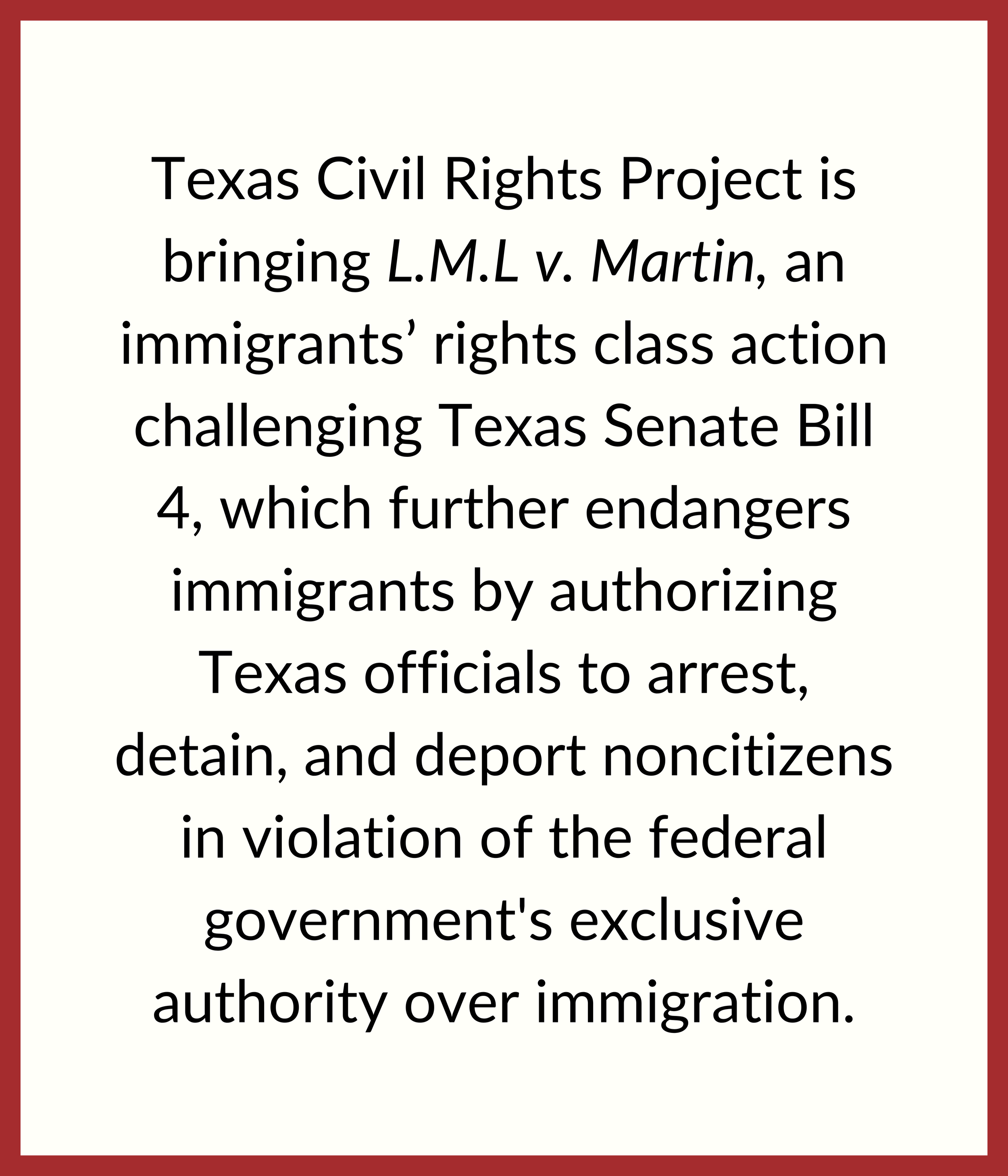
Impact Fund provided a grant of $20,000 to support this case.
In addition to its controversial recruitment campaign, DHS also began mobilizing state police. Within weeks of returning to the White House, the Trump administration revived a federal program allowing ICE to deputize local officers as immigration agents and unilaterally disbanded its DHS advisory board. The deputization of local officers was shelved more than a decade ago amid concerns about civil rights abuses. Now, it’s back without any oversight.
The revived program allows state and local law enforcement agencies to sign partnership agreements with ICE, effectively weaponizing local police for immigration enforcement. It also enables local officers to question and detain anyone they suspect of immigration violations. Because suspicion can be based on nothing more than the color of someone’s skin, the program has quickly devolved into blatant racial profiling.
Some police officers have opposed the program, saying that it erodes community trust, makes their job more difficult, and reduces local response times. Ignoring these concerns, ICE continues to expand the program. More than 2,700 agreements have been signed with law enforcement agencies across the country.
Bounties, Not Badges
In October 2025, through the program described above, DHS also began offering reimbursement opportunities to state and local law enforcement agencies to incentive partnership with ICE. State and local agencies are reimbursed for salaries of officers involved in the program, in essence transforming local police officers into de facto ICE agents and removing officers from regular law enforcement duties.
The program also includes performance bonuses based on the number of immigration arrests. The more people agencies arrest, the more money they receive. If agencies meet their targets, they will receive up to $1,000 per eligible task officer. Such a payment structure incentivizes agencies to push for increased immigration arrests, even when based on little more than suspicion.
Drastic Tactics
In addition to commandeering local law enforcement, ICE has adopted other drastic new tactics to meet its extraordinarily high arrest quota.
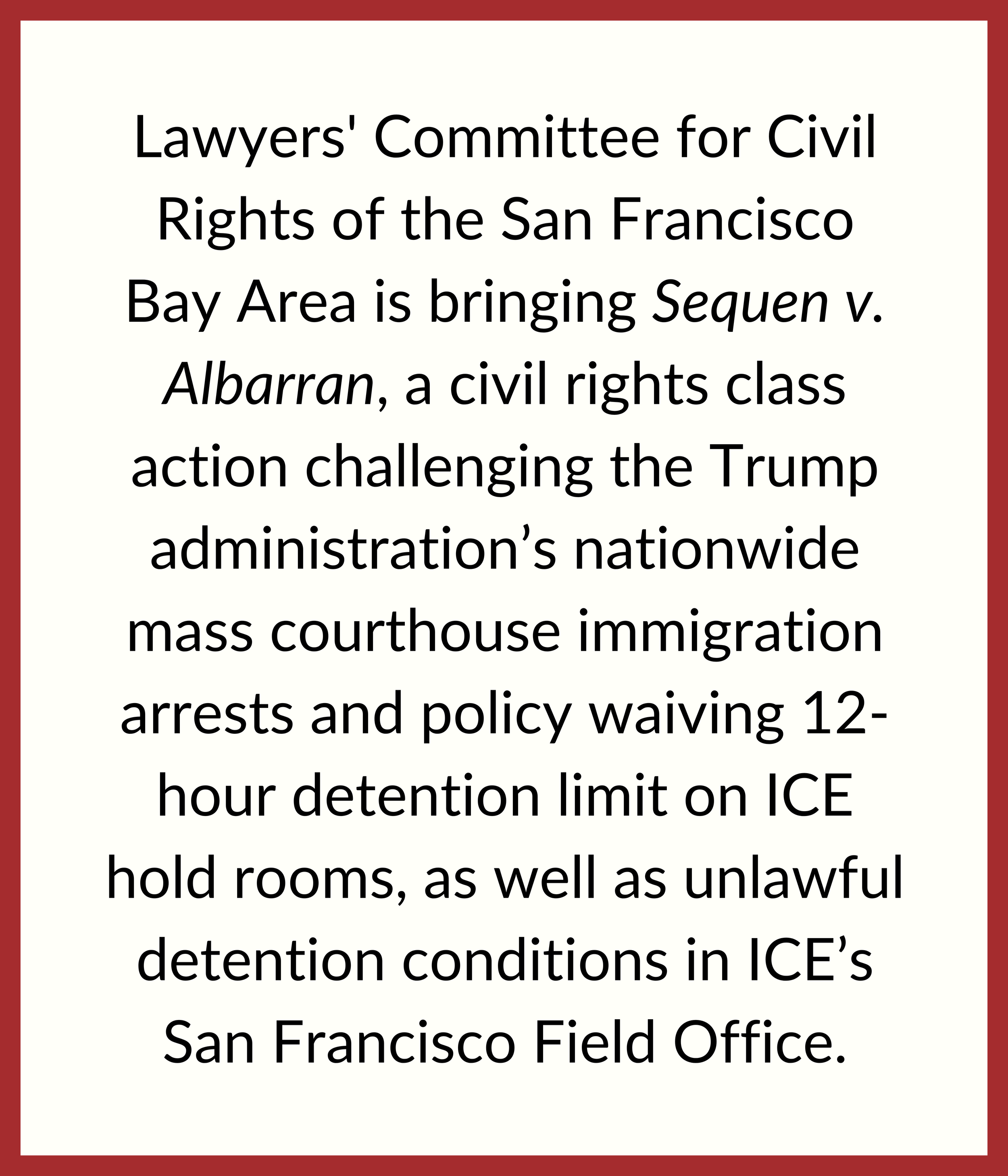
Impact Fund provided a grant of $20,000 to support this case.
To meet its monthly arrest numbers, ICE began co-opting other federal law enforcement agencies, including the Federal Bureau of Investigation, the Homeland Security Investigations agency, and the Drug Enforcement Administration, among others. Newly deputized federal agents were diverted from their normal priorities and reassigned to immigration enforcement.
ICE officers also began using increasingly aggressive tactics. ICE has arrested people at courthouses, hospitals, and schools. And in 2025, ICE began authorizing agents to use force to enter homes without a warrant signed by a judge, even though our Fourth Amendment constitutional right says exactly the opposite. ICE claims it can enter homes without a judge’s signature by relying on an internal administrative document, created and signed by an ICE agent, instead of a court-issued warrant.
ICE is arresting people first and asking questions later — acting on its own legal theories and pushing the bounds of the law.
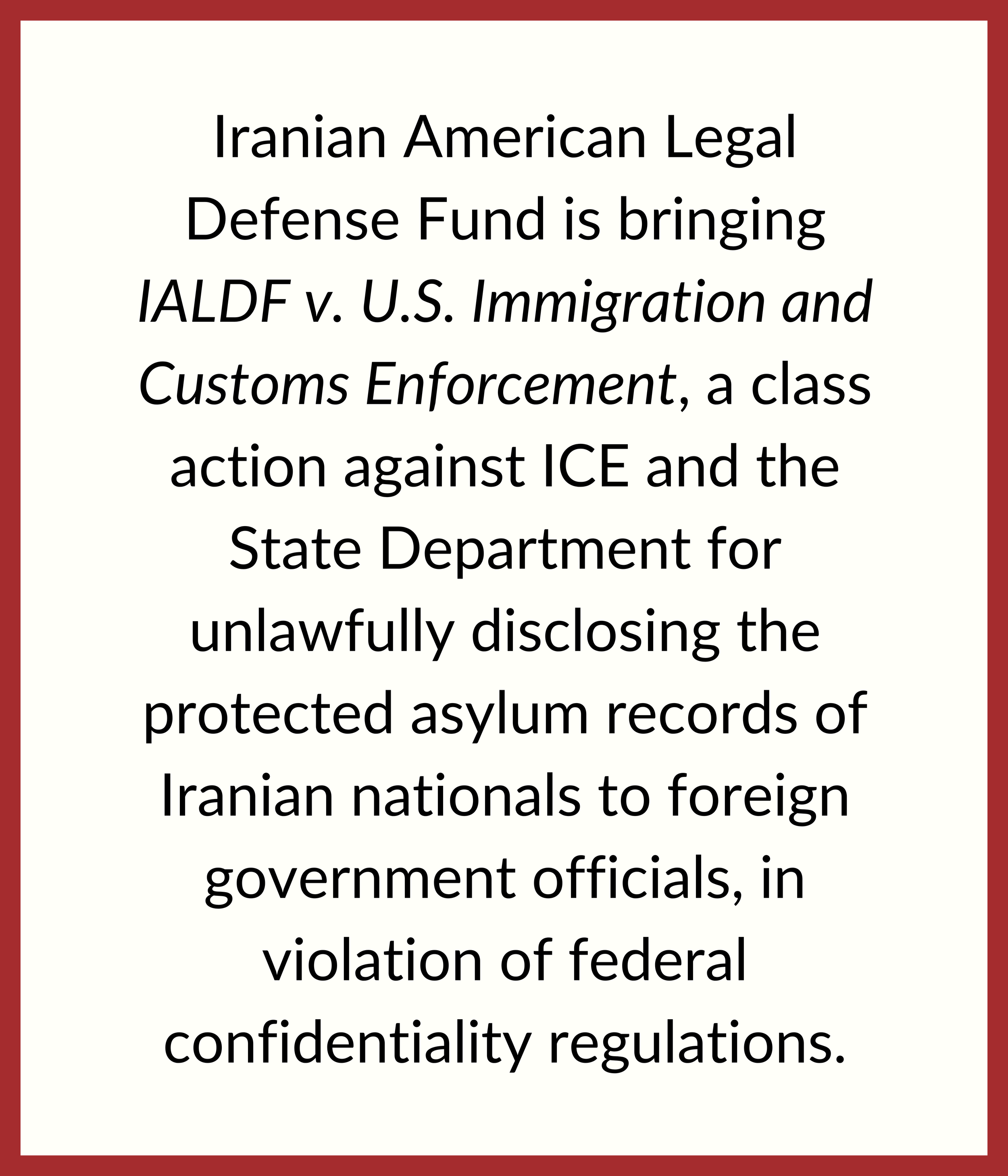
Impact Fund provided two grants totaling $25,000 to support this case.
The false sense of urgency created by the quotas has also exacerbated racial profiling. After the Supreme Court cleared a path for ICE agents to use skin color as a reason to question someone about their legal status, ICE agents have been further emboldened to target people based not on suspected criminal activity, but simply on perceived foreignness.
Citizens Arrested
The system created by arrest quotas is dehumanizing, illogical, and dangerous. Even with these drastic new tactics in place, it is implausible that ICE could arrest 3,000 immigrant criminals each day. So, desperate to meet its quotas, ICE is arresting immigrants without criminal records and even citizens.
Dayanne Figueroa, a citizen born on U.S. soil, was driving to her job as a paralegal in Chicago when an unmarked SUV swerved and crashed into her car. ICE agents exited the SUV with their guns drawn, dragged Figueroa out of her car, and handcuffed her on the pavement as she struggled. The Washington Post reported that Figueroa told the agents that she was a U.S. citizen after being loaded into a van with two other handcuffed and terrified detainees. They replied saying, “No one is going to help you. You’re all criminals.”
George Retes is an American citizen and a disabled Iraq War veteran. ProPublica reported that Retes was driving to his job at a farm in Ventura, CA when he was caught between ICE agents and protestors resisting a massive raid. Agents broke his car window, pepper sprayed him, and threw him to the ground. Retes was arrested and disappeared into the detention system for three days without being able to contact anyone. His family couldn’t find him and weren’t given any answers by the law enforcement offices they desperately called. After his release, Retes recalled that the ICE agents knew he was a citizen but “didn’t care,” and that one official laughed at him, saying that he shouldn’t have gone to work that day.
Even when they are not arrested, ICE is still attacking U.S. citizens for no reason other than appearing foreign and being in the wrong place at the wrong time. Rafael Veraza was in a grocery store parking lot west of Chicago with his wife and baby when he noticed a commotion around several unmarked vehicles belonging to ICE officers. The family decided to leave and had begun driving away when an SUV passed them and an officer filled their car with pepper spray. Veraza and his wife weren’t detained, but they rushed their crying one-year-old baby to the hospital, where a poison control specialist warned that the exposure could cause long-term damage to her lungs and eyes. The Washington Post reported that Veraza, who was born in the US, recalled the incident with anger and frustration: “I don’t know how I’m going to explain it to my daughter one day—that she got pepper-sprayed on our way to buy Pampers and milk.”
No Human Being Is Illegal
Contrary to the administration’s narrative, most of the people arrested by ICE have no criminal history, even those who are here without legal citizenship.
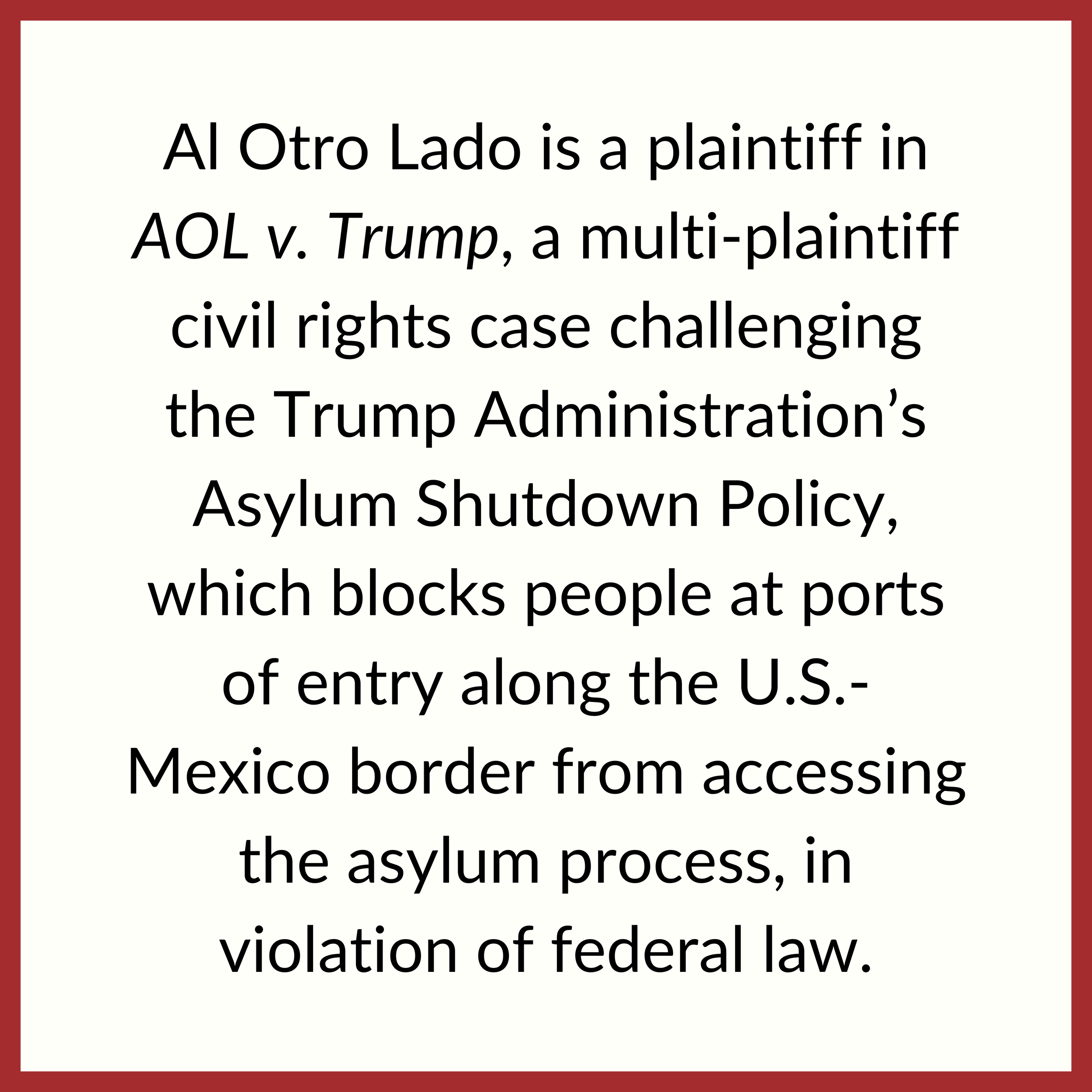
Impact Fund provided a grant for $39,000 to support this case.
74% of immigrants in the U.S. hold permanent or temporary legal status, and of the remaining 26%, a large portion entered the country legally but overstayed their visa. Only a small minority entered without authorization.
According to the Supreme Court, simply being present in the U.S. without legal status is not a criminal offense, but a civil violation. Living in the U.S. without authorization or entering lawfully and staying longer than permitted are civil violations, considered by the law to be on par with running a red light or failing to clear snow from a public sidewalk. Only entering without authorization is a crime.
Between October 1, 2025, and November 24, 2025, 73% of the people arrested by ICE had no criminal convictions, and only 5% had a violent criminal conviction.
Blank Check to Brutalize
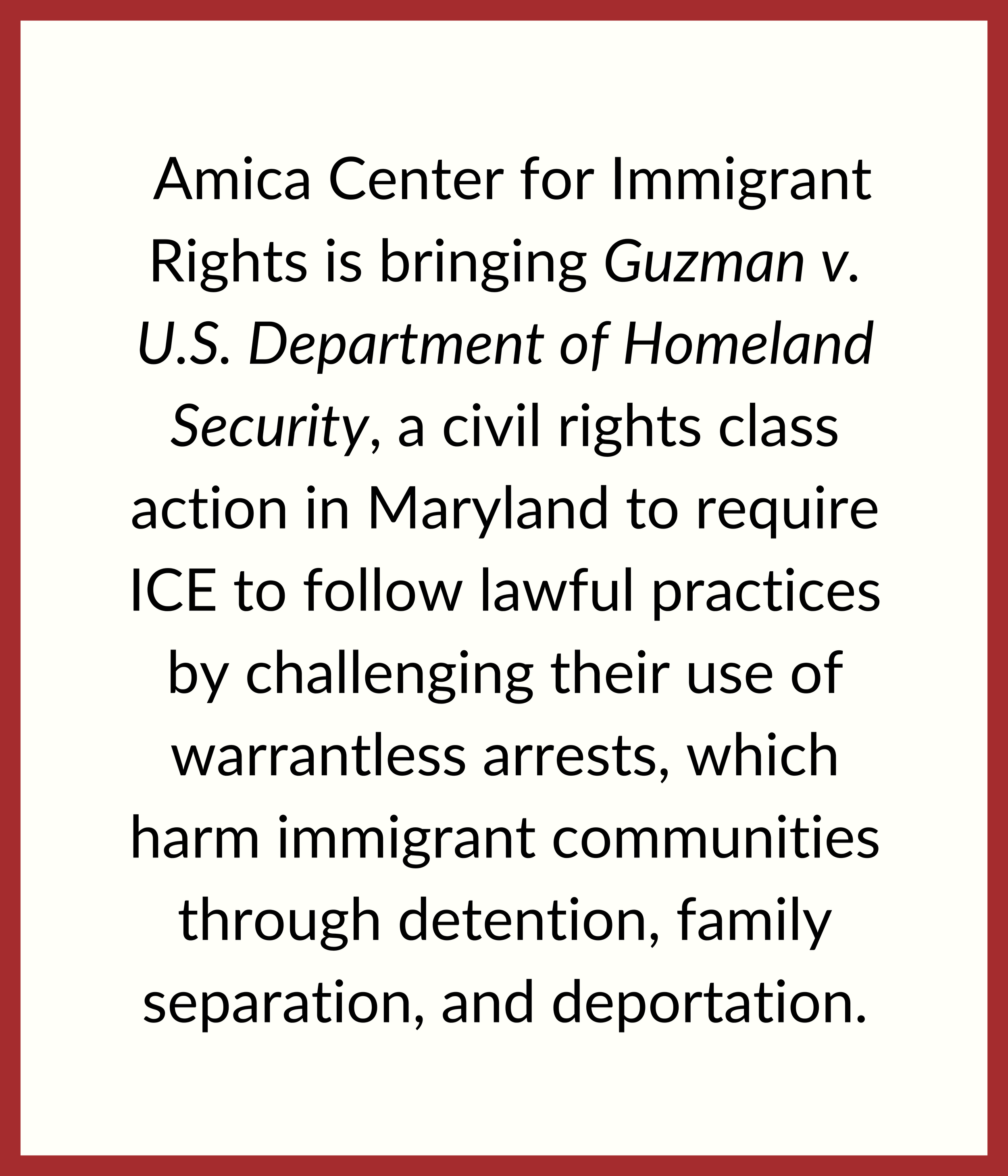
Impact Fund provided two grants totaling $17,500 to support this case.
A masked agent in Los Angeles pressed his knee to a woman’s neck until she lost consciousness. An agent in Houston put a teenager into a chokehold, which left red welts on his neck hours later. An agent in Massachusetts pressed his fingers into a father’s neck until his eyes rolled back and he started convulsing.
After George Floyd was murdered by a police officer in 2020, police departments and federal agencies across the country banned chokeholds and other uses of force that could restrict breathing or blood flow. However, in the last year, ProPublica found more than 40 incidents of ICE agents using life-threatening force against immigrants, citizens, and protestors, and more than 170 incidents of ICE arresting American citizens, often while wearing masks to conceal their identities.
The Real Threat
ICE is not arresting “millions and millions of criminal aliens” or the “worst of the worst” as the deportation agenda claimed. Instead, it is arresting our family members and neighbors, everyday people who are raising their children, working, going to school, and have or are pursuing legal citizenship. Immigrants, people of color, non-native English speakers, and others reasonably fear that they will be mistakenly perceived as “criminal aliens” based on the color of their skin—and then brutalized, kidnapped, and removed from their homes and families.
The administration insists that the American people should fear the immigrants in their communities. But more and more Americans consider the real threat to be the masked agents who lurk at bus stops to arrest parents with young children, wait at courthouses to grab law-abiding people, pepper spray babies, chase farmworkers through fields, and kill American citizens.
ICE claims they are protecting us from the immigrants invading our country. But who is actually endangering our loved ones and communities? Immigrants are not the real invader; ICE is.
How to Help
Share “Know Your Rights” cards in your community — multilingual legal rights information so individuals know they can remain silent and ask for a warrant.
Buy from immigrant-led and immigrant-friendly businesses in your community.
Become a “constitutional” or “legal” observer to monitor law enforcement activity and document violations when they do occur — check if your local immigrant or refugee rights organization offers trainings.
Train to be an accompaniment volunteer — accompany individuals to their workplace, school, court appearances, and ICE check-ins.
Interfaith Movement for Human Integrity (IM4HI) Nueva Esperanza Accompaniment Teams
For more ways to help, see the National Immigration Law Center’s Solidarity Guide for Defending Immigrant Communities
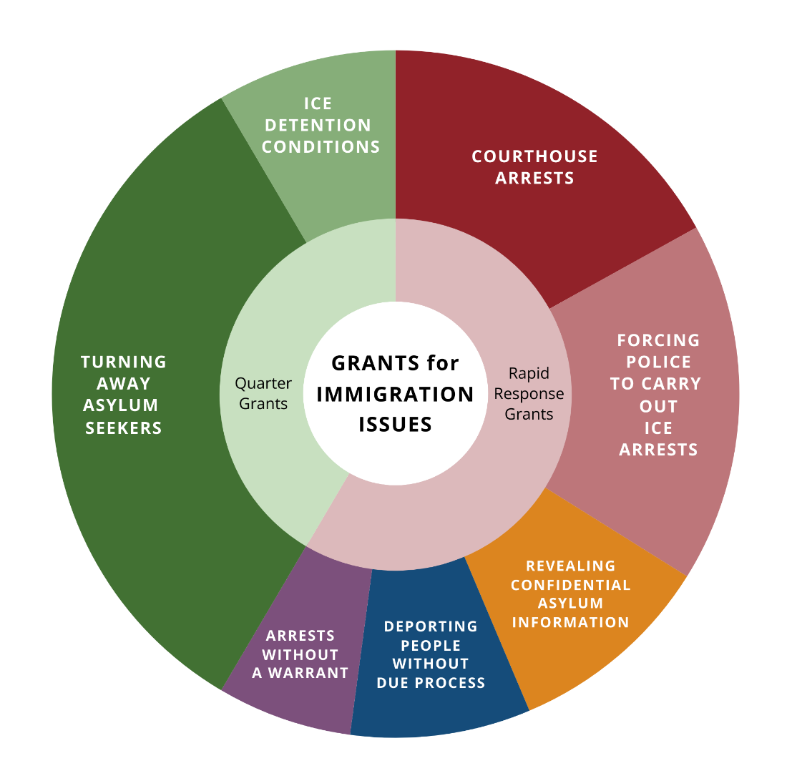
Immigration Cases We’ve Funded in 2026:
Production Credits
Author: Simone Faulkner
Researchers: Simone Faulkner, Joshua Kay, Megan Flynn, Amy Daniewicz
Editors: Lindsay Nako, Lucy Barton, Amy Daniewicz
Web Producer: John Henry Frankel
Web Editors: Teddy Basham-Witherington, Lindsay Nako